Finding an endangered moss again, nineteen years later
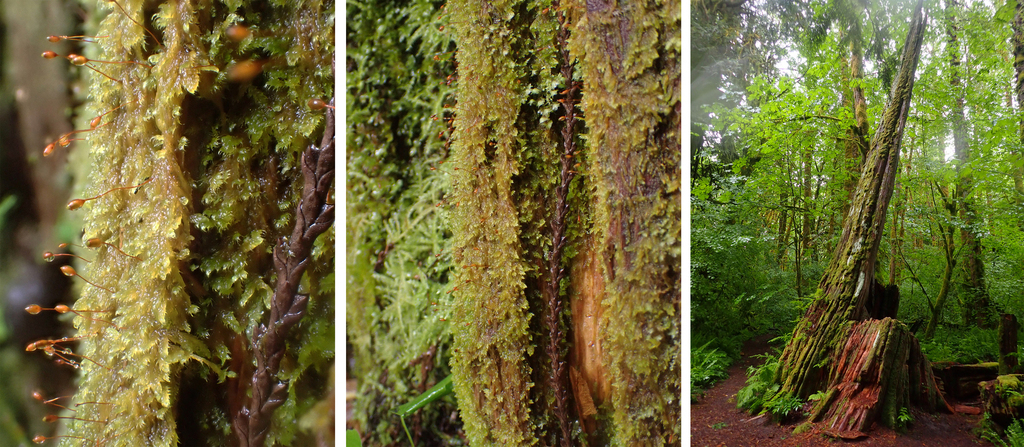
Zooming in on the rare moss Brotherella roellii revealed a nice flush of sporophytes! My one and only iNaturalist Observation of the Day.
In May 2025, after several trips that had turned up nothing, I finally found Roell’s brotherella moss (Brotherella roellii) growing on an old-growth western redcedar snag at the Cheakamus Centre in Squamish, BC—the unceded lands of the Sḵwx̱wú7mesh Úxwumixw/Squamish Nation. The site alone was worth the search: a cedar that stood like an ancient rainforest ruin, cast in rays of light which beamed down through a gap in the canopy.
Brotherella roellii is endangered in Canada, where it is now thought to be endemic. Populations once known from Washington State are believed extirpated, leaving the Fraser Valley and Howe Sound region of BC’s Lower Mainland as the species’ entire remaining range. Why it persists in the particular places it does, and not others, is the question behind ongoing research I have been pursuing with Emma Menchions (UBC), looking at how temperature, moisture, light, and forest structure interact to define the conditions this moss needs.
This particular population was first recorded in 1916 and last seen in 2006. Confirming it was still there nineteen years later in 2025—healthy, and possibly one of the most robust populations known in the region—was great news for the Átl’ka7tsem/Howe Sound Biosphere Region. The species appears to be gone from at least one of its historical sites elsewhere in Squamish, which makes protected refuges like the Cheakamus Centre increasingly important as development continues to fragment lowland coastal rainforests in British Columbia. Indeed, its persistence here helped the Squamish River watershed earn recognition as a Key Biodiversity Area of global significance, owed in part to the region holding roughly 10% of this species’ entire known population.